- Autoplay NEXT:









Cooking with Kurma S1-E11 Traditional Indian Sweets - 1

- Vegetarianism / Meat Eating
- In this edition you will learn how to prepare a few of the thousands of varieties of Traditional Indian Sweets prepared from milk, sugar, grains, fruits, nuts, spices, essences and even vegetables. Sweets like these have been offered in temples in India for centuries. Gulab jamun--beautiful rose-scented balls in syrup, semolia halva--a great favorite and chick-pea fudge balls or laddus.
Kurma's Gourmet Vegetarian Cooking Video Encyclopaedia.
Broadcast on television from New York to London to Sydney, Cooking With Kurma brings the best of cruelty-free cooking into your kitchen. "Kurma... has a gentle style that is a happy contrast to the frantic and frenzied style of most television cooks. His subtle wit and enthusiasm, combined with his fabulous-looking dishes, can renew your culinary excitement and creativity." -- Vegetarian Times
Kurma's cooking shows have been broadcast on 178 PBS stations across the U.S., BBC2 and The Learning Channel in the U.K., STAR satellite TV from Hong Kong to Turkey, Russia, The Middle East, Indonesia, Malaysia, India, China and most recently in Australia on SBS and Foxtel.
"Meat-eaters and vegetarians alike will certainly find something to fit the bill in More Great Vegetarian Dishes of the World on SBS with Kurma Dasa" (Screen Watch, The Australian, May 2000)
"Kurma's likeable personality makes it a totally fun experience." (Hinduism Today)
"Cooking With Kurma .. is an excellent and welcomed addition to our cooking program line-up." (Jeff Clarke, Houston PBS)
"We really enjoy Kurma's no-frills, no gimmicks television show. His enthusiasm for vegetarian food is infectious. ... Highly recommended." (Brisbane Courier Mail, December 2000)
"While Kurma may be the high priest of vegetarian cuisine, you don't have to be a vegetarian to enjoy his cooking. It's fresh, original and delicious!" (The Canberra Chronicle, December 2000)
"Our rating: simply delectable" (Canberra Times, March 1999)I'm Korma. Welcome to the Gourmet Vegetarian Cooking video encyclopedia. This edition, we're going to show you how to prepare a few of the thousands of varieties of traditional Indian sweets prepared from milk, sugar, grains, fruits, nuts, spices, essences, and even vegetables. Sweets like these have been offered in temples in India for centuries.
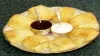
Gulab Jamun, beautiful rose-scented balls in syrup. semolina halva, a great favorite, and chickpea fudge balls or ladoos. So let's begin. Classic semolina halva. I think this must be one of the most famous of all Indian desserts.
I know in our restaurant in Melbourne people come from miles around to enjoy halva and if it doesn't happen to be on the menu that day they're very disappointed. Halva is actually a general term to mean any sort of grain or fruit which is cooked down with sugar. So this particular recipe for halva calls for semolina. Semolina is a natural wheat product and it forms the basis of this dish.
Here we've got one cup of semolina. Along with that we're going to use one half of a cup of butter, two tablespoons of raisins, a teaspoon of grated orange rind, two tablespoons of fresh grated coconut and a quarter of a teaspoon of nutmeg. We're also going to put in some walnuts, that's a quarter of a cup, one cup of sugar and two cups of water. So how to make orange raisin and walnut halva?
Well I'll show you. Over here we've got two pots. In one of our pots we're going to add our water. Along with our water we've got sugar.
Let's turn the flame on there. Along with the water and sugar we're going to add our raisins, nutmeg, coconut and orange. Give it a bit of a stir. Now we have to bring our syrup to the boil.
Meanwhile in the other pot let's put our butter so this is the same formula as for making your sauteed rice if you recall for every one cup of rice you use two cups of water so similarly for every one cup of semolina we're using two cups of water so with our two cups of water there we've got our one cup of semolina here now our semolina is now going to be added to our melted butter into our melted butter goes our semolina so when you add the semolina you'll notice that it soaks up all the butter after some time you'll notice that the semolina grains will start to go darker in color they'll give off a very nutty aroma they'll shrink a little bit and they'll give off some of the butter that they've initially soaked up now when your water comes to the boil turn it right down to a simmer and put a lid on it we don't want any of that to evaporate otherwise the halva will not turn out so well now as you toast your semolina you should make sure that you You don't leave any patches unstirred in order that the grains are roasted evenly. It's practically unlimited what you can use in halva as far as a semolina variety is concerned.
Any variety of nuts or fresh fruits, dried fruits, sweet spices can go in halva. It's practically unlimited. It's a beautiful dish for a cold winter's morning or a cold winter's night. When you serve halva, you'll notice that people go wild over it.
Notice now how our halva is half cooked. When you stop stirring for a moment, the butter starts to bubble out, see? As I was explaining, our grains shrink a little bit as the roasting process goes on. Notice also how semolina now is a slightly darker color.
It's changing its shade to a tan color. Now at this stage you could add your liquid and you'd have a light golden coloured halva. I'm going to roast my grains a little darker to make a darker halva and a darker halva has a more roasted flavour also which I find very nice. Let's have a check on our liquid here, it's simmering away, the lid stops it evaporating so we have the correct amounts.
Now I think this is practically done, so I'm going to now add my walnuts and roast them for a few seconds in our halva. And I'm going to toast them in with the semolina just for about a minute. Now at this critical stage we've got to do two things, we've got to turn our flame to low on the grains and we have to turn our gas full underneath our liquid. Bring your liquid to the boil like so and now we're ready to add our liquid to our grains.
Add liquid to the grains, one go. Now this is a very critical stage also, keep stirring that semolina and water mixture which is now very quickly turning into our finished product, the halva. At first it will have this soupy consistency and it will start to spit by the way so step back you know that you don't burn yourself stir very rapidly keeping it moving all the time and you'll notice that the halva will start to thicken up and it reaches a certain stage where it leaves the side of the pan it's fast approaching that stage now you'll find that it becomes stiffer and harder to stir see that how it's coming away from the pan one lump this is a few seconds away from being done. There it is, it's coming away from the side of the pan now.
So that's done. Turn off the flame, put a lid on there and let it steam for about two or three minutes. So it's been about five minutes now and our halva should be nicely steamed. Yes, there it is, hot golden halva.
I don't think it's going to be very difficult to give this away. Halva can be served on its own. You can serve it with hot custard. You can serve it with whipped cream you can serve it cold whichever way you serve halva there's always a great demand whichever way you serve halva it always gets eaten very very quickly i'm going to show you now how to make a very famous sweet called gulab jamuns rose scented balls in syrup they're actually quite amazing and the most amazing thing about them is what they're made of simply milk sugar and water but you wouldn't tell by looking at them now they're a bit of a challenge to make but if you can master these then people will flock in droves to eat your gulab jamuns because they're actually the most amazing sweets now the ingredients are quite simple but the way to make them is actually the is the real essence now the syrup should be made in advance this is four cups of sugar and four cups of water that have been brought to the boil together we're We're going to add a tablespoon or a little bit of concentrated rose water there.
That gives a beautiful rose flavor. Now, as far as making the little balls are concerned, I'm going to show you how to do that, so watch carefully. Here we've got some full cream milk powder, two and a half cups. And here we've got some all-purpose or self-raising flour, half of a cup.
If you like, you can add cardamom powder to your gulab jamuns if you want them to have a very slightly spicy flavour. You can miss out the cardamom if it's not your favourite. You also need some amount of cold milk. I've started off here with about three quarters of a cup.
We're not going to use anything like that much, but the idea is to have enough cold milk on hand to mix up the dough. So the idea is that we're mixing all these things together into a very soft dough, and then we're going to deep fry them in ghee. Now, it has to be clean ghee, uncooked in, and it should be very, very low temperature. In other words, when you stick your finger in the ghee, you can keep it in there for three seconds before taking it out.
Careful when you make that experiment, by the way, in your kitchen, otherwise you can burn yourself, but I already knew that was cool enough to use. So what we're going to do now is mix all our ingredients together in a bowl here. The one thing about gulab jamuns is that if it doesn't work, don't worry, try again, because it's not the easiest of preparations to make. to make. Notice how I'm sifting in the flour here.
This is important so there's no lumps. I already sifted the powdered milk before. Now let's dry, now let's mix up all our dry ingredients. I'm going to add my cardamom powder I think.
Mixing our ingredients until they're all nicely blended. Like so. Now we're going to add our cold milk. Let's start off by adding that much.
The idea is we've got to make a dough which is going to be just the right consistency so you can roll it into balls. I would suggest you use your hands for this because you've really got to just tell by the feel of the dough if it's right or not. A little more milk. Gather it all together into a nice lump.
A fraction more milk there we are one lump of dough now at this stage I'm going to knead it just for a little while it doesn't really need like a normal dough because after all it's just powdered milk but we have to just spread it around a bit till it's a smooth mixture like so now I'm going to scrape my can of this off my hand so not to waste any of it and we'll be ready to continue with our next step. I'm going to scrape any excess dough I have off my hands here so as not to waste any. Now let's take a little ghee on our hands to moisten them and let's pinch off little pieces of dough and roll them into balls about half inch in diameter. As soon as you roll a nice ball which shouldn't have any cracks in so it's nice and smooth, it into the ghee and the first thing you'll notice is that nothing happens.
This is a good sign because the ghee, as I told you, you can stick your finger in for three seconds and then it starts to get a little hot. So the idea is at first the gulab jamuns will sink to the bottom. So while that one's still down there, I'm going to roll a few more. Now the idea is to roll them as quick as you can.
I'd go for about this much ghee, I'd go for about perhaps 12, 15 gulab jamuns because they will swell up. There's nothing worse than having a beautiful batch of gulab jamuns in the ghee and then finding that as they swell up there's too many to fit in the pan because they do swell up quite considerably. So there's number four. Of course if you have someone helping you, you can really move making gulab jamuns.
This recipe makes about two dozen or more but they'll go pretty quickly. Now, as you can see already, some of them have come to the surface. This is after about a couple of minutes. And if you look carefully there, there's little bubbles coming to the surface.
And they're moving around. Now, I'm not moving them. It's almost like gulag rams have a mind of their own because they start rolling around. See them rolling around there?
And there's another one that comes to the surface. And I think there's another one that's about to come to the surface there. It's actually quite amazing. If you like, you can move the gear around a little bit just to encourage them.
But at this stage, don't touch the gulag rams themselves. see how they're expanding this is the reason why you should only put in a small quantity at the beginning otherwise they bump into each other at this stage and start pushing each other out of the pan now it's been about 15 minutes now see how our gulab jamuns are going golden color and they've swelled up even more we're getting pretty close to the time now where they have to come out of the ghee it's very important to keep your gulab jamuns moving that's why i'm always pushing them around and submerging them under the ghee with the aid of my slotted spoon this is one of the secrets of a good gulab jamun now our gulab jamuns are done notice how they're that nice shade of brown all over so i'm going to turn off the ghee and very carefully lift them out of the ghee and put them in our syrup so what you do is you just take three or four at a time, shake out all the ghee. Don't put them in a colander, but put them straight into your batch of sugar syrup.
And there's our first batch of gulab jamuns, golden, juicy, sweet balls. I like to soak them in the syrup for about 24 hours before serving them. Sometimes you can even leave them for longer. They're actually good a week later even, or even two weeks later, but generally speaking there's none left by then.
After 24 hours they look like this. Notice how these are darker, they're a little larger and they're much juicier. They even swell up a bit more in the syrup and the test of a perfect gulab jamun is that when you pick it up you can squeeze out lots and lots of juice from it like so and that's a nice gulab jamun and when you put it back in the syrup it soaks it all back up again. Oh, there's one final thing, that's how to eat your gulab jamuns.
Now you might say, well obviously I just put it in my mouth, but the point is how to put it in your mouth. Don't try to nibble it or bite a piece off because the juice will just explode all over you. Best way to eat a gulab jamun is to put it straight in your mouth so the juice explodes where it belongs. You know chickpeas are not only great in different types of savoury and vegetable dishes.
They're also very versatile for making different types of sweets, notably laddu. Laddu is a very famous Indian sweet made from chickpea flour. We're going to show you how to make that now. Chickpea flour can be purchased at any Indian grocery shop.
You'll notice chickpea flour has this lovely golden colour. Before you use it, you should sift it. Now for this recipe we're going to use one cup of sifted chickpea flour. We're going to use between 1⁄2 and 3⁄4 of a cup of butter.
We're going to start off with 1⁄2 a cup. 1⁄8 of a teaspoon of cardamom powder and 3⁄4 of a cup of powdered sugar. So the first thing we're going to do is melt our butter. Let's take our butter over to our pan here and melt it.
The idea is that we're actually going to toast our chickpea flour in melted butter. And as the chickpea flour toasts, It turns a golden colour, develops a very, very beautiful nutty flavour. And this is the basis of our very simple but very delightful sweet laddu. You should obtain unsalted butter for this job, lest you have a salty laddu, because obviously sweets shouldn't be salty.
So you can either use unsalted butter or of course you can use ghee. I prefer to use butter, it gives it a more richer flavour. so when the butter is melted or just about melted you can add your chickpea flour now always remember ladu has to be stirred constantly so you should pick a pan that you can easily stir and a pan which has a good heavy bottom so there's our butter melted now let's add our chickpea flour now the first thing that happens when you add your chickpea flour is that it soaks up all the butter like so and it turns into a sort of a slurry. Now you should toast your chickpea flour in the butter for about 10 minutes and you'll notice that as you do so it will darken in colour, it will develop a rich nutty flavour and it will go a little looser in texture.
Don't forget to keep stirring. You You should look out for any patches of chickpea flour that's sticking on the bottom. If you allow it to scorch, it will spoil the subtle flavour of the laddu. Notice our laddu here is now getting very dark.
It's almost been ten minutes now. Have a look. See it's going that beautiful chocolatey colour now. And that's done.
Now take it off the flame, or turn off the flame, add our cardamom powder, gives it a very nice aromatic flavour. your sifted powdered sugar which you should carefully mix in. Now the reason I've suggested that you use powdered sugar for this is because if you use ordinary granulated sugar then your ladoo will be crunchy. Notice here how the icing sugar is blending in very nicely to form a smooth paste after mixing in the raw ingredients for the ladoo. The next stage is you should roll it into balls but I don't suggest you try that now because it's red hot and you'll burn your hands so leave it to cool for about one hour I have over here a batch that I've previously made it's cool it's ready to roll notice here how it's now cool and soft and easy to roll you can pinch off pieces like this and it very easily roll them into balls like so so this stage they're still a little soft if you like to make them firm and easy to handle After they're rolled into balls, you can refrigerate them.
And here's our finished product, laddu. Well, there we have it. Just a few of the thousands of varieties of sweets that can be prepared in the Indian vegetarian cuisine. Out of simple ingredients, you can create a myriad of different sweets.
And it's said that a meal is not complete without a sweet. So, happy eating.