- Autoplay NEXT:








The Sacred Cow -- Why do Hindus Believe the Cow is Sacred -- 1980 Documentary

- Farms / Self Sufficiency
- This documentary investigates the situation of the cows and bulls in India in 1980. It shows, that contrary to the Western opinion, it is far better for India for India to protect her cows instead of slaughtering them for meat.
The cow and the bull, as established in this film, alive contribute far more to India's economy in terms of food and energy than could be achieved by slaughtering them for meat.
Of course it was made thirty years ago so a lot of time has passed and the situation has certainly changed in some ways, however the basic principle is still the same.The popular image of India. Backward and poverty ridden. 650 million people jostling each other for food and a livelihood. A few so called modern cities and the rest a vast rural slum.
India. The rooted impassivity of an ancient civilization clinging to an outmoded pastoral culture. This is the popular image, but like so many popular images, it's not really accurate. The people may be poor, but they are self-sufficient.
They are reasonably well-fed and simply but adequately housed. They don't have much of the technology that passes for civilization in the West, but then they don't have many of our problems either. What they do seem to have is a peaceful and satisfying outlook on life that is all too often missing from our own culture. But Westerners tend to see this contentment as laziness.
They mistake the simplicity of the people for ignorance. Westerners, beginning with the British, have been trying to change India for centuries. Yet today, little has changed. Most of the population still lives in the vast countryside.
And they live much the same as they have in the past. A past that stretches back thousands of years. Are they stubbornly clinging to their ancient superstitions and beliefs? Or do they simply prefer their way of life to our own?
A case in point is the sacred cow. Though it sometimes seems the whole country is overrun with animals, Hindu India will neither kill nor eat her cattle, the native humpback zebus. It is particularly hard for Westerners to understand this worship of cows. After all, we live in the land of the golden arch, where the hamburger reigns as the single most popular American dish.
Western economists say that beef alone could solve India's food problems and perhaps lay the base for a lucrative export trade. It's in this context that cattle worship and cattle protection have been attacked for over a century as lunatic obstacles to farm management. The sacred cow, we use that very phrase to describe perversity, any blind irrational loyalty that slows progress or impedes logical problem-solving but it often pays to re-examine our own perspectives and try to view other people's beliefs without prejudice let's take a closer more objective look at the sacred cow and try to understand why it is so important to India to begin to understand the zebu cattle controversy it's necessary to go into the countryside, for India is fundamentally rural. As the population is multiplied, land holdings have been split and split again, so that most contemporary farmers have a mere acre or two, hardly enough to warrant the purchase of a tractor.
And even if the farming plots were increased to the point where tractors became cost-effective, they would be useless because of India's unique weather. As soon as the monsoon rains have softened the cracked earth, it must be plowed and planted. Even a day's delay in planting can greatly reduce the yield because of the searing heat that soon ends the growing season. Under such conditions, bullocks are ideal, for they can plow wet soil without overly compacting the earth, as tractors do.
As in family farms everywhere, the whole household must work. And in India, most work is still done in the traditional labor-intensive way. The staples are wheat and rice, where all good Hindus and many Muslim and Christian Indians as well are vegetarian. Their main source of animal protein is milk and its byproducts.
The churn is a part of every household. The fact is that cows produce much more usable protein in the form of milk, butter, and cheese than in the form of beef. It takes seven times more acreage to produce a pound of beef than it does to produce a pound of milk. For India, with its already strained resources, the allocation of so much more acreage for the production of beef would be disastrous.
Modern reformers have contended that the introduction of new intensive farming techniques would increase the total yield per acre so that eventually beef could be introduced into India's diet. They say this would improve the people's health, which would also increase the overall productivity of the nation. They also argue that because of religious taboos, most Indians would not agree to these changes. And at least on this point, the reformers are right.
Cow slaughter and meat eating are strictly prohibited by India's ancient scriptures. These scriptures, called the Vedas, date back some 5,000 years and are acknowledged to be the oldest written religious teachings in existence. They are also the most elaborate. According to the Vedas, the human diet should consist of grains, fruits, vegetables, and dairy products.
Meat eating is specifically condemned. It is described as both cruel and unhealthy and is regarded as extremely detrimental to spiritual advancement. The penalty, or karmic reaction, for slaughtering animals for food is severe. Meat eaters must take birth again and again to suffer in turn at the hands of every animal that they have ever eaten.
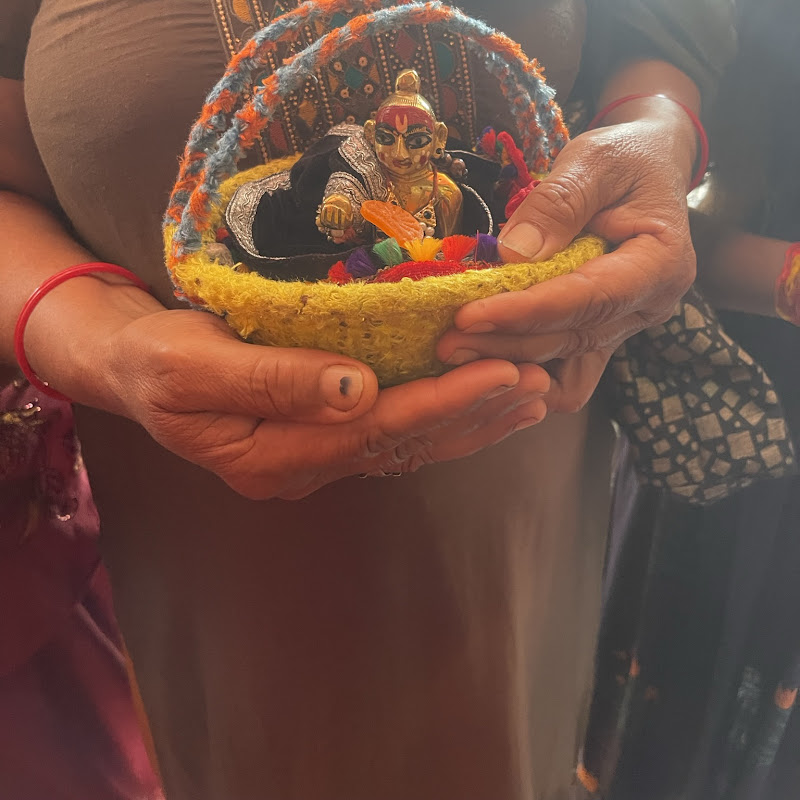
Most Indians firmly believe in these laws of karma and with the promise of such harsh consequences they are understandably reluctant to flaunt these laws by eating any kind of meat. The Vedas say that all animals are supposed to be protected, but above all, the cow is considered to be sacred. This is Lord Krishna. According to the Vedas, the supreme personality of Godhead.
When he incarnated on earth 5,000 years ago, he appeared as a simple cowherd boy, and his childhood pastimes were spent in caring for his beloved cows. One of his names, in fact, is Gopal, friend and protector of the cows. Because of this close identification with Krishna, the cow is honored and revered as sacred. In addition, the cow is frequently seen in the Vedas as a symbol for religiosity and for the other virtuous qualities it exhibits, qualities like charity and mercy. because of the cow's generosity with its milk or motherhood because of the tender loving care cows give their young and because of the importance of cow's milk in nurturing our own young.
Small wonder that all but two Indian states have anti-cow slaughter laws and that all of India would protest and riot if beef consumption were in any way encouraged. But putting religious and moral considerations aside for the moment, there is still a controversy, even in the West, as to whether meat-eating is actually healthy. India certainly has its health problems, mainly due to urban overcrowding and inadequate sanitation and medical facilities. But it is interesting to note that high blood pressure, heart disease, arthritis, and cancer, the greatest medical problems of the West are almost non-existent in India.
Recent studies have confirmed that vegetarians everywhere suffer a far lower incidence of these diseases than do meat eaters. However backward we may consider rural agrarian India, perhaps we should not be so eager to inject our own unsolved problems into that simple but basically self-sufficient lifestyle. But critics have said that it's also a marginal way of life, one that produces few surpluses. From their universities and government administrative posts, critics pointed out that if the farmer's cow turns barren, he's lost his only chance of replacing the work team.
And if the cow goes dry, the household has lost its milk and butter. Fortunately, in reality, the situation is somewhat less precarious. neighbors of the same village share their food freely and if one family loses its cows or bullocks friends and relatives will lend their animals to help out in a culture so compassionate that it prohibits cow slaughter helping one's neighbor is an even more sacred obligation but strangely enough it is this cultural compassion that is the source of most of the controversy. India's persistent refusal to kill her aged and useless cows has drawn the heaviest critical attack from reformers. Farmers will not kill sick bullocks and aging cows for food or even sell them for money to buy replacements.
Instead they're kept alive and there are even nursing homes to look after some of them. The homes are called goshalas. Some are government agencies, and some are private charities set up by rich Hindus seeking spiritual grace. In hard times, farmers can board their aiding cattle here free of charge, reclaiming them when times get better.
Critics say, why not just let them die off? They say that India can't afford to keep these useless cows that compete for croplands and precious foodstuffs. A persuasive argument. But India actually spends less on its sick and aging cattle than Americans spend on nursing their cats and dogs.
And India's cattle population is six times as large as the American pet population. To the Indian farmer, his cattle are members of the family, to be cared for at least as well as pets. And since the farmers also depend on their cattle for their livelihood, It makes both good economic and emotional sense to see that they are well taken care of. In the slack time between harvest and the next planting, the cattle are washed and groomed the way proud owners clean and polish the family car on weekends.
The Indian farmer takes pleasure in adorning them, especially for the twice yearly cow festivals, one of which is held in the late summer at the end of the rains and the other one right at the end of the harvest period. much the same scene is taking place all through rural india festooned and garlanded the cattle have been herded to the local common most of the villagers who assemble arrive with treats such as succulent mustard greens while the cattle forage stolidly as cattle do the celebrants sprinkle them with water and make their thanksgivings our western culture looks with revulsion at people who cook and eat their cats and dogs we shouldn't be surprised that most of india feels the same way about anyone who would cook and eat a cow but critics say that india cannot afford this luxury they've been saying that if india will not eat the cow the cow will eat india and on the surface it would seem to be true India has over 200 million zebus, one-fifth of the world's cattle. With so many animals in competition, they say not even the healthy ones get enough to eat, at least by Western standards.
Exasperated critics have been saying it for a century. If only India didn't worship the cow. If only we could get rid of all the useless animals. Many still say it.
But about 15 years ago, investigators began to re-examine the whole system of cow protection. What they found was that for India, the protection of cows and bullocks is not only useful and practical, but actually essential to the nation's economy. For in fact, cattle are India's greatest natural resource. consume only grass which grows everywhere and yet they produce not only essential nutrition but fertilizer fuel and more power than all of india's generating plants india runs on bullock power 15 million bullock carts moving some 15 billion ton kilometers of goods new studies in energetics have shown that bullocks do two-thirds of the work on the average farm Electricity and fossil fuels do a mere 10%. Bullocks not only plow the fields and haul the produce, but also grind the sugar cane to extract the syrup, which is then boiled down and shaped by hand into sugar cakes.
Bullocks turn the presses that render the linseed oil. Converting India's bullock power to machinery would cost an estimated $20 to $30 billion, plus far more in fuel, maintenance, and replacement costs. And even a Zebu cow gives an efficient quantity of milk considering its low upkeep cost. Frothy from being boiled, cooled to drinking temperature by the time-honored technique, it's the favorite Indian refreshment.
Farmers' cheese and sweetmeats made from milk solids are other popular delicacies. The biggest energy contribution of cows and bullocks is actually their dung. India's cattle produce 800 million tons of manure every year. In the countryside, it is the children's job to see that none is missed or overlooked.
Hardly the kind of thing Westerners would want their children to touch, let alone bring home. But in India, the people learn from the ancient Vedic scriptures that cow dung is different from all other forms of excrement. Far from being untouchable, cow manure is considered pure. Obviously, Westerners said, this is the kind of absurd conclusion you arrive at when you start worshipping animals.
And once again, Westerners were wrong. After exhaustive scientific tests, it turns out that cow dung is not only completely free from harmful bacteria, but also does a terrific job of killing them. It is a natural antiseptic, every bit as good as Lysol or Mr. Clean.
But most of the cow manure is plowed in as fertilizer at no cost to the farmer or to the world's fossil fuel reserves. The remainder is used for fuel. It's odorless and burns without scorching, giving a slow, even heat. So a housewife can count on leaving her pots unattended all day or return at any time to a grill that's been preheated for short-order cooking.
To replace dung with coal would cost India an additional $1.5 billion a year. Set out in terms of the energy equation, India's cattle culture begins to look far more economical and attractive. Those who so strongly advised changes in the past are now less certain. Time after time, they've seen their hopeful solutions undone by the hard lessons of practical reality.
A good example is the water buffalo, once seen as the perfect answer to India's cow problems. India's farmers were encouraged to begin using them and breeding them in the hope that they would one day replace the sacred cow. Water buffaloes are not held sacred, and they are an abundant source of milk. But water buffalo must wallow once a day and are unable to survive where water is scarce.
This is no small drawback in India. The water buffaloes did prove to be heavier and stronger than the zebus, but to the farmers, this just meant providing more feed. Like the American muscle cars of the 50s and 60s, the water buffaloes were no match for the lightweight economy models, the trim, fuel-efficient zebus. So, back to the drawing board.
And now the debate has shifted. Unable to come up with a workable alternative to the cow, the reformers have devised a new argument. Why not keep the old cattle culture, they say, but modernize it, streamline it, and make it much more efficient? So there began several ambitious programs for improving the breed, using pedigree bulls bought from Europe, as well as artificial insemination. insemination.
But there were problems, and with the benefit of hindsight, it is easy to see why. The new hybrids couldn't work until they died of old age. They had no hump of survival to last out droughts and famines, and they didn't come dirt cheap. The new hybrids did give three or four times as much milk as the zebus, but this too turned out to be a problem because there was no efficient way to distribute the milk to India's widespread population.
India's old-fashioned system of distribution is highly decentralized, primitive by Western standards. Again, the solution seemed simple. With pasteurization, bottling plants, and other sophisticated Western methods of distribution, everyone in India could have fresh, uncontaminated milk, as we do in the West. In their zealous pursuit of efficiency, the reformers even set up experimental automats to dispense skim milk powder, milk, and cream.
And behind all these efforts at modernization was an unstated belief. People would soon begin to appreciate the abundant rewards bestowed by these new Western deities, technology and efficiency, and cow worship would eventually disappear. But once again, problems kept cropping up. And in the end, it was modernization that failed to prove its value.
For the Indian farmer, the old ways remained the best. Take pasteurization, for example. In India, everyone likes to drink their milk piping hot. So Indian housewives have always boiled their milk anyway as a matter of taste.
For India, pasteurization would be a waste of time and money. And speaking of money, it seems that the proponents of modernization had conveniently forgotten that modern Western cattle technology is powered by machinery, not men, and consumes vast amounts of energy. Tractors, giant harvesting machines, milking machines, and daily pickups by refrigerated tankers using modern highways. And this is only the beginning.
In the Western distribution system, there are huge bottling plants, refrigeration in every store, and refrigerators in every home. With India's searing climate, refrigeration costs alone would make the milk too expensive for 95% of India's population. India was beginning to realize that these Western gods could be very demanding indeed. They gobbled land, energy, and money at an alarming rate, and India, lacking the vast natural resources of the West, simply could not afford to replace the zebu.
The wonderful thing about zebus is that they get along very well on practically nothing. Things humans can't use, like wheat stubble, rice straw, and husks. Far from being useless and impractical, the Zebu is an efficient, natural recycling machine. Indeed, it is something of a miracle.
And so it eventually became clear that this ancient system of cow protection remains the most practical and efficient agricultural model for India today. But it was not just economics that decided the fate of India's cows. Western-style cattle breeding depends on scientific culling, killing off the less productive animals. The ancient Vedic scriptures that form the basis of their religious and moral beliefs say that such cruelty to animals leads to a disregard for human life.
Historical evidence would seem to confirm this. Vegetarian cultures generally exhibit less aggressive behavior and go to war less often than societies that eat meat. Standing on the brink of World War III, Perhaps our own society should give this possibility some serious consideration. There are many ideas in the ancient Vedas that should merit our serious attention.
Of course, like most people, we naturally tend to think of our own country and way of life as being the best. We point to our great standard of living and to the fantastic achievements of our science and technology and conclude that this is how everyone should live. But we neglect to mention the nightmares that come with the American dream. Pollution, drug abuse, crime, and a host of new medical problems like cancer, heart disease, and high blood pressure.
We also have to contend with rising suicide rates caused by increased anxiety and depression. The problem is that in filling our bellies so well, we've neglected to provide sufficient nourishment for the soul. There is much we can learn from the rich spiritual heritage of India, but only if we are willing to question our own values, attitudes and beliefs. After all, between the Zebu and Western technology, which is really the sacred cow?