
- Autoplay NEXT:












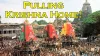
Rathayatra - Pulling Krishna Home

- Festivals
- Narrated documentary footage from Jagannath Puri, a holy town on the Bay of Bengal in the Indian state of Orissa, about 500 kilometers south of Kolkata. It follows preparations for Rathayatra, the festival of chariots: the town's 150,000 residents prepare to welcome about a million pilgrims while three gigantic wooden chariots are built for the deities Jagannath, Baladeva, and Subhadra, who for centuries have enjoyed the distinction of state deity in Orissa. Two weeks before the festival the deities are bathed in a public ceremony and then humorously retired to a sick room with a 'cold' for a fortnight, Rathayatra being the celebration of their recovery.
On the day itself, hundreds of thousands gather along three kilometers of grand road as the deities are carried out: first Lord Jagannath's scepter Sudarshan, then Baladeva and Subhadra, and finally the Lord himself, hoisted onto his sixteen-wheeled chariot Nandi Bhoja by scores of devotees. The Sankaracharya, one of four living representatives of the Vedantist school, climbs each chariot in homage, and the Gajapati Maharaja, the traditional king of Puri, sweeps the chariots with a golden-handled broomstick and sprinkles sandalwood water before an elephant-headed procession sets out. Without any steering, the chariots are pulled by ropes held by hundreds of men, women, and children, maneuvered through sharp curves, and after camping overnight they resume toward Gundicha Temple, described as Puri's spiritual equivalent of Vrindavan, the childhood village of Lord Krishna.
The narration also describes Puri's Maha Prasad, the food prepared daily for the deities in a kitchen said to be the world's largest, feeding up to 100,000 people with 56 dishes on ordinary days and nearly 100 on special days, all strictly vegetarian and free of chili, garlic, and onion. It explains the inner meaning of the festival: the Vrindavan devotees are pulling the kingly Lord Krishna back to his idyllic playground for a symbolic week's holiday before the trinity returns to the main temple.
The film recalls that five hundred years ago, during this same Rathayatra, Lord Chaitanya Mahaprabhu and Nityananda, described as incarnations of Krsna and Baladeva, danced in ecstatic transformations recorded in the Chaitanya Charitamrita, at which moments Jagannath's chariot would mysteriously stop. It notes that inspired by Lord Chaitanya and especially His Divine Grace A.C. Bhaktivedanta Swami Prabhupada, the Rathayatra festival has been exported worldwide since 1971, now held in cities from Los Angeles and New York to Sydney, London, Paris, Rio de Janeiro, and Moscow. The closing words affirm that devotees 'live in India or England or America, but we are all his children,' united as brothers in this one festival.Near the Jagannath Temple, preparations are underway wherein Jagannath Puri, a holy town in the Indian state of Orissa. Puri is 500 kilometers south of Kolkata on the Bay of Bengal. Its wide pristine beaches of golden sand are well loved. The steaming tropical climate doesn't faze these fishermen who dress and work as their forefathers did. While on the beach, this young and physically challenged man sings his heart out to God. In town, preparations for the grand festival of the chariots have begun.
Hotels are starting to display their no vacancy signs. This is how it is every year. The 150,000 inhabitants of Puri are about to welcome a million pilgrims from all over India and abroad. It's time for shopping, religious items, handicrafts and handlooms of recent saris. But the pilgrims are also keen to buy sets of three statuettes, Jagannath, Baladeva and Subhadra in their miniature forms. These three are so venerated in Orissa that for centuries they've enjoyed the distinction of state deity.
It is in their honor that three gigantic wooden chariots are being constructed before the gaze of onlookers. In a few days, the three personalities will be taken onto the chariots. Devotees will gather in throngs along the spacious grand road and pull the vehicles by ropes with their bare hands. Jagannath means the lord of the universe. This face is God's face, incarnated in an enormous block of wood, two meters high and weighing half a ton.
With a black complexion and two big round eyes, Jagannath sports a radiant smile that is famous as belonging to him and to him alone. Two weeks before the festival, Jagannath, Baladeva and Subhadra are bathed in a public ceremony where large volumes of water are poured over them. Afterwards, it is customary for the deities to catch a cold as if they were ordinary mortals. In great fun, they retire to a sick room where they will be bedridden for a fortnight.
Ratayatra, the festival of the chariots, is a celebration in great pomp for their recovery. The construction of the chariots is complete. It is the dawn of the Ratayatra day. The procession is scheduled for midday, but thousands of the faithful have already gathered. By mid-morning, the crowd has swollen to tens of thousands. And by late morning, to hundreds of thousands, stretched along the three kilometers of the grand road. Standing in the torrid heat of summer, many keep smiling.
Like Jagannath, others meditate on the imminent appearance of the beloved three. And there are still others. As the rhythm intensifies, time has come. One by one, the three deities will be ushered through this gateway and carried onto their thrones. But first is Sudarshan, Lord Jagannath's sceptre, symbol of sovereignty. Sudarshan opens the way for the three and is carried by a group of pandas, the priests. Walking around the three chariots, they trace a circle to sanctify the space. In this picture, Sudarshan stands next to the three deities.
The three deities are the three deities of the three deities of the three deities. The white deity is Baladeva, Jagannath's direct expansion, his brother. Baladeva grants spiritual strength to the faithful, and they are now acclaiming him. One may wonder why the deity is being handled so roughly. It's because the Lord is just too heavy to be carried. A forward swing of the massive frame, combined with the thrusting motion at the base, lifts the Lord forward in steps of about a meter.
Now that Baladeva has gone onto his chariot, it's Subhadra's turn to appear. Amidst great applause and cheering, Subhadra is seated in the center of the trinity. She is a feminine aspect of God. Lord Jagannath's younger sister in the tradition. The trinity of Puri predates the Trinarti. The trinity of Puri predates the Trinarti. The trinity of Puri predates the Trinarti. The trinity of Puri predates the Trinarti. The trinity of Puri predates the Trinarti. Then, the ascended rata of the ancient Buddhists.
A similar festival is held before they were driven out of India in the 7th century. This may give an idea of how ancient Rathiatra is. Subhadra, being less heavy, is here carried through a narrow passage, just big enough for her size. Her face resting on a pillow of human arms. Gazing straight to the sky, the Goddess climbs up to her throne in big strides. It is now time for Lord Jagannath to appear.
Through the ages, Jagannath has been worshipped in three major traditions of India Hindu, Jain and Buddhist, not to mention local Aboriginal creeds. Hence the name Jagannath, Lord of the Universe. From the point of view of today's temple administration, however, not all of God's flocks are welcome inside his temple. For the non-Hinduborn, this is the only chance in a year of getting a sight, a darshan of the compassionate Lord in Puri. There, we can already glimpse those two familiar round eyes staring endearingly from behind the main entrance.
It is said that in a time long past, King Indrajumna commissioned the Puri deities and engaged the architect of the demigods in carving them. Before the work was finished, however, the king took a peek which he had promised not to do. The heavenly sculptor walked off the job and the king installed the deities unfinished as they were. It is also said, on the other hand, that Krishna wanted these very forms to be worshipped. Why?
Because they are the best expression of the ecstasy he felt together with his brother and sister when they heard stories of Krishna's childhood plays in his native Vrindavan village. Jagannath thus embodies the mood of stunned ecstasy. Every 15 to 20 yards, the Pandas take a break. Not to forget Jagannath himself, whose cooperation in the affectionate struggle of his devotees must be commended. Let's move on. We now see Jagannath being brought to the front of his chariot.
The Lord will soon be hoisted along this tilted platform up to his throne where media photographers have been posted. But for a few moments more, the devotees delight in showering Jagannath with this very particular tenderness. A rare intimacy seems to be unfolding before our eyes, between a crowd and his cherished child. Once upon his throne, Jagannath will again dominate the world. But though he may be God, he can also enjoy a few moments of informal bonding with his worshippers.
Jagannath looks as though floating in an ocean of his devoted souls. In this exceptional public mixing, with scores of them, lifting the Lord up the platform can begin. This is no small matter, quite a challenge in collective coordination, and quite a spectacle. Once Jagannath is comfortably seated atop his chariot, a last few rituals are in order before departure. For a start, let's bring Jagannath's coffer of personal effects to him. He must not be missing anything on his journey.
Puri has two traditional figures of authority, one religious, the other political. The religious figure is the Sankaracharya, one of four living representatives of the Vedantist school. He is the elderly man with white hair, who is now proceeding up the platform. Each year, he climbs up and down each chariot to offer his homage to each deity. After Sankaracharya, the king of Puri is getting ready to bow his head at the feet of the deities. Although Maharajas have lost all political power in modern India, they are still highly venerated there.
As for the Maharani, she'll remain at the palace today. The Maharaj is thus led away, left alone on his royal palanquin. The elephant, India's royal carrier, heads the procession. And with what style? They say stroking the elephant's trunk brings good luck. The palanquin follows behind. And for the events to follow, none other than the king himself, Gajapati Maharaja tells us. ...or the sweeping of the chariots. When the lords are brought from inside the temple, they're placed on the chariots, and then they are decorated.
After the decoration is over, I have to go from my house to the chariots, and I perform what is known as Gajapati Maharaja Seva. Seva, service. Service, service to the lord, and in the most humble way. First I go on to the chariot of Lord Balabhadra, or Balaram. And after offering this worship, then I sweep the chariot around the place where the lord is seated, with a broomstick, which has got a golden handle. And after sweeping the chariot, I sprinkle sandalwood water, and then dry sandalwood powder.
This is a sign of auspiciousness to purify the chariot. And after Lord Balaram's chariot, Balabhadra's chariot, I go on to Lord Jagana's chariot, and then Subhadra's chariot, and then the worship is over. I come back to the house, and then the pulling of the chariot begins. Without further ado, the drivers, made of wood, take control of the horses, also made of wood. But the real driving force will be the hundreds of men, women, and children, who are about to pull on ropes to move the chariots forward.
This is how thick the ropes are, a good ten centimeters in diameter. Wrong start. A wheel stop must have been left in place. And despite the remarkable width of the grand road, the three chariots cannot depart side by side at the same time. Lord Balabhadra, his chariot is called Taladhwaja, and it's about 46 feet tall, and it has got 14 wheels. So Lord Balabhadra, the elder brother, moves first. This is the sister, Subhadra, the chariot is called Darpa Dalana, or Devi Dalana, and she moves next.
The chariot is slightly smaller, it's the smallest among the three, and it has got 12 wheels. The end is Lord Jagannath's biggest chariot of them all, with 16 wheels, and his chariot is called Garudhwaja, or Nandi Hosha. And most of the people go and pull Lord Jagannath's chariot, because he's Lord Jagannath. Actually, maybe because he is the most important of all living beings in the universe, Jagannath is going to keep his entourage waiting for him all afternoon. And how could anyone complain before such an innocent smile?
Meanwhile, Taradhwaja and Dharana Balana, the chariots of Jagannath's big brother and little sister, have rolled on way ahead. No matter, it's not a race. Half a kilometer down is the first curve. Now, this is an important stage, because while the chariots have wheels, they have no steering system. So, it's a case of pulling en masse to the side of the curve. Still in his starting block, it looks as though Jagannath is finally about to make a move. After Jagannath's impressive departure, we're now at the front of the parade with Baladev.
He is negotiating his second curve, this time to the left. The security staff takes an active part in the maneuver. They are Puri's police. And for them, this parade is a sacred duty as much as a professional one. They hold a rope stretched all around the moving chariot to keep the crowd from getting too near the giant wheels. All right, well, Baladev won't go any further today. All three deities will camp out for the night, and the parade will resume in the morning. As for Jagannath, he is now busy catching up with his siblings.
So, we are all going to make sure you get to see about his new ride. And we'll see you soon. We'll see you soon. Bye-bye. Bye, bye. Bye, bye. Bye. Bye. Bye. Bye. Bye. Bye. Bye. Bye. Bye. Bye. Bye. Bye. Bye. Bye. Bye. Bye. Bye. Bye. Bye. Bye. Bye. Thank you. Thank you. Thank you. Thank you. Thank you. Thank you. Puri is famous for its Maha Prasad. Maha Prasad means the food that is prepared and offered daily to the deities. There is no need for God to eat. We know that.
But what God enjoys in a dish is the love and devotion of the cooks and the taste thereof. After the offering, the food is sold to the public and is called Maha Prasad. Puri Temple's legendary kitchen is probably the world's largest with its capacity to feed as many as 100,000 people each day. Only a sample of every dish is physically placed on the Lord's altar because there are no less than 56 preparations on ordinary days and nearly 100 on special days.
Over the centuries, the kitchen's recipes and its high cooking standards have given the temple the top culinary reputation in the whole of India. As for quantity, we are talking in the area of 7 tons of cooked rice on normal days and 90 tons on special days. Maha Prasad is free from hot chili, garlic and onions. More importantly, it is entirely vegetarian as Jagannath does not permit animal slaughter. Maha Prasad is sold at the Ananda Basin which is a marketplace located inside the temple precincts.
Foreigners and non-Hindu born must buy Maha Prasad through an insider for a token fee. Like this poor Brahmin who is delivering us his two hands full of the delicious Maha Prasad. Mmm, thank you! To give an idea of how sacred it is, Maha Prasad is the only food a devotee will agree to eat in the company of a non-devotee. As for the cows, they are always happy sharing the remnants with dogs and even crows. Having camped out comfortably in the open, the Divine Triad is soon to resume its course. By the way, where are they heading?
To Gundi Chagha, the Garden House. This place is the spiritual equivalent to Vrindavan, the childhood village of Lord Krishna here in Puri. Now, this is the inner meaning of the whole festival. The Vrindavan devotees are pulling the kingly Lord Krishna back to his idyllic playground where the simple milkmaids and cowherd boys have been dying in separation from him ever since duty called young Krishna away from them many years before. Now, Jagannath yearns to resume his most loving pastimes during a symbolic week's holiday.
After this holiday, the Triad will return to the main temple and the festival will be over. But let's get back to the parade. The festival is at its peak. Rhythms and songs are heard in all directions and dances follow. Suddenly, the stores on wheels are on the move. They must clear the road for the chariots. Just in time. The drivers are already restless. From the top of their vehicles, Balaram seems ready. Subhadra is cozily wrapped up and Jagannath smiling as ever. Now, we are back on the road with the two lead chariots.
But where is Jagannath's chariot? Oh, here it is. But has it somehow mystically shrunk? No. The children of Puri also have their own parade with their own mini chariots. Many pilgrims touch their heads to the ground in worship as the chariots pass. And some even collect the sacred dust from the rust left by the massive wheels. While Big Brother Baladev and Little Sister Subhadra have already reached their final destination, Lord Jagannath seems to be grappling with the last curd.
Nandi Bhoja, the chariot, urgently needs to be repositioned before it crashes into some building. Custom forbids the chariot from moving in reverse. And it has been seen in the past that whole walls or electric poles, have had to come down for the chariots to complete a turn. Once, a whole house had to be demolished to allow for the onward march of a chariot. Will this blackish hut suffer the same fate this year? Thankfully, no. Only a small bit of damage as the wheels hub merely knocks down a few brakes.
Now that the three chariots have completed their odyssey, the devotees are allowed to approach the Lord, touch him, worship him, and make their offerings. The faithful climb aboard the chariots to prostrate themselves and congratulate the Lords for completing their journey. The chariots soon look like fortresses under siege. Offerings of burning ghee lamps and succulent coconuts are made. It is time for prayer. Spoken or silent. Jagannath loves sweets. And so do his devotees. So do the foreign tourists.
The pilgrims slake their thirst with a cool drink. Plenty of free and safe drinking water is available to the thirsty. Now is the perfect time for this leper to beg alms by lying on his bed of thorns. He lies there for hours, seemingly oblivious to the festivities or to the pain and pleasure of his body. Maybe his mind is filled with the mantras of chanting parties. Like this young man on crutches we had met on the beach. Whenever we need him, he's always singing his heart to God.
It's time for kirtan, the responsive singing of sacred mantras, by a crowd overflowing with devotional fervor. Mithai Gauranga. They are the incarnations of Krishna and Baladeva who came to earth in the 16th century AD. Their importance is still growing today on account of the ecstatic chanting and dancing that they performed 500 years ago during this same Rathayatra festival. The ecstasies of Gauranga, who is better known as Lord Chaitanya, are described in the scripture relating the life and teachings of Sri Chaitanya. Here is an excerpt.
When the great master danced and jumped high, eight wonderful transformations indicative of divine ecstasy were seen in his body. His skin erupted with goose pimples and the hairs of his body stood on end. It flowed with perspiration and sometimes with blood. He made the sounds in a voice choked with ecstasy. Tears came forcefully from the eyes of the Lord as if from a syringe and all people around him became wet. Sometimes he appeared stunned and sometimes he rolled on the ground. Thus reads the Chaitanya Charita Amrita.
During such ecstasies, the chariot of Lord Jagannath would, mysteriously, come to a halt and it was impossible to get it to start again by pulling. The eyes of the Lord were, without a doubt, fixed on the avatar of devotion. The last eighteen years of Sri Chaitanya's life on earth were spent in a continuous state of devotional trance inside the walls of this house. It is by the inspiration of Lord Chaitanya and his followers, especially His Divine Grace A.C.
Bhaktivedanta Swami Prabhupada, that the De Ratha Yatra Festival has been exported all over the world since 1971. On the Los Angeles seafront, down New York's Fifth Avenue, in Sydney, Durban, London, Paris, Barcelona, Rio de Janeiro, and Moscow, the Ratha Yatra Festival has been held every year in dozens of cities, big and small, across the globe. It is so popular in some parts that local communities have adopted the festival as one of their own local celebrations. We live in India or England or America, but we are all his children.
So we are really all brothers. We are all united together in this one festival. Very real sense.
