
- Autoplay NEXT:











Ankor Wat Cambodia Temple Documentary

- Temples
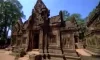
- Part of a documentary on the Ankor Wat Temple built in the middle of the 12th century. The name Ankor Wat means "The Temple of the Capital". The towers all imitate the shape of a close-up lotus flower. It was built by the King Suraya.
their feet. For the next four years the horrors of the killing fields continued with almost everyone in the country forced to grow rice. Any sign of dissent meant instant death and maybe as many as two million people, a quarter of the total population, perished. It was a tragedy based in part on the mistaken idea that the ancient reservoirs were giant rice growing machines.
But the more specialists examine the reservoirs and temples the more mysterious they become James Goodman has been taking precise measurements of the heights of all the ancient buildings this ruin was once an early ancient capital of the Khmer but was soon abandoned why James thinks he found the answer the site is too low and would flood badly every few years what the ancient Khmer kings were looking for Angkor was a site near to the expanding and contracting Tonle Sap Lake, but on high enough ground to stay dry even in the wettest of years. The Tonle Sap, not the ancient reservoirs, provides the answer to how the ancient Khmers grew so much rice. As the lake gradually expands and shrinks, the Khmers use the newly exposed wet lake bottom to plant new rice. At Angkor today, you can see rice being harvested in one spot and only a few miles away being planted.
It is a system that allows for almost continuous rice production and was almost certainly the economic backbone of Angkor's glorious achievements. So why build reservoirs at such huge cost of men and materials? No practical reason, it seems. It was simply what god-kings had to do.
And this glorification of the king through gigantic building projects reached its zenith with Angkor Wat, the single most astonishing achievement of the entire angkor period angkor wat the greatest of all khmer temples was built in the middle of the 12th century at the same time as notre dame cathedral in paris as a building it is as impressive as the great pyramids of egypt with its vast outer moat causeway and giant central towers and as artistically distinctive as the taj mahal Angkor Wat, the name simply means Temple of the Capital, is a glorious mixture of qualities. Its wide, smooth, grassy exterior is balanced by the sculpted loveliness of its carved interior. Its highest tower is as tall as any cathedral in Europe, and yet the building never overwhelms the visitor. And the final touch of genius, the towers all imitate the shape of the closed-up bud of a lotus flower.
And here is the man who built it all, sitting under the 15 parasols that denote a Khmer king, surrounded by his court, his army, and his Apsaras, the court dancers. King Suryavarman spent most of his life atop of a war elephant fighting Cambodians' traditional enemy, the Vietnamese. But from the loot gained from these wars, he created a masterpiece. For many, Angkor Wat is simply the finest ancient building ever created.
But Angkor Wat, astonishing though it is, isn't the only great Khmer temple. The empire that produced Angkor Wat was about to produce a king who would eclipse even this glory. We know what he looks like. This is the famous statue of Jayavarman VII being carefully restored in the National Museum of Cambodia.
It's a portrait of a devout Buddhist deep in meditation. His head gives an instant impression of power, with hair so closely cropped that the shape of the skull is revealed. The eyes remain closed, serene, meditative, and the mysteriously smiling lips convey a sense of spiritual peace. Yet the firm square jaw is the mark of a man of iron will, the greatest king the Khmer ever produced, the Napoleon of Angkor.
And he needed to be a fighter. Only a few years earlier, the Vietnamese attacked and looted Angkor. But Jayavarman got his revenge, and in a great battle on the Thanh Le Sap Lake, he defeated his enemies. These are Cham soldiers from what is today southern Vietnam in their distinctive helmets resembling an upside-down lotus.
As losers, they are being eaten alive by crocodiles. To prevent any future Vietnamese invasion, Jayavarman fortified his capital with immense walls and filled the moat with crocodiles. Within the moat is now tropical jungle, once a thriving some million people. This at a time when London had fewer than 30,000.
And at each of the city's five gates, he built soaring towers with their great entranceways of gods and demons wrestling with sacred snakes. And on each tower, a vast enigmatic face with the famous smile of Angkor. Archaeologists debated for decades whose face it is. It is now generally agreed that the face is a composite of Jayavarman's own face, the compassionate face of the Buddha.
Right at the center of his city of Angkor Thom, the greatest of all Khmer kings, Jayavarman VII, built his temple mountain, the strangest of them all. Look closely at its 54 towers. Staring down at you are 200 large faces carved in stone. all Jayavarman. The faces with slightly curving lips, eyes placed in shadow by lowered lids, utter not a word, and yet force you to guess much, wrote a visitor here in the 1920s.
Around the time the Madna Carta was being signed in an English meadow, Khmer sculptors were carving these heads, some of the greatest works of art ever created. A century ago, a French visitor wrote, friendly yet ironic smiles, make the Bayan Temple an extraordinary building to ponder in the daylight. But at night, under a full moon, it becomes a temple from another world built by aliens, whose ideas and conceptions are entirely unfamiliar and strange to the 20th century. The Bayan Temple is also a window into the past.
Its carved stone walls are key to the life of a lost civilization. Here a woman gives birth, a fire is blown alight, a pig is cooked, lice removed from a friend's hair. Just after these murals were finished, a Chinese visitor to Angkor was making his way through the Tonle Sap, through the sunken forest to spend nearly a year at the Cambodian capital. His name was Chu Ta Kwan, the year 1296 and by great luck he kept a diary that has survived.
From the diary we can tell that the houses of ordinary folk were on stilts, very similar to houses in the Cambodian countryside today. We know that ordinary people had palm leaf roofs. Tiles were forbidden to them. They cooked outside and inside their houses they had no tables, benches, basins or buckets.
Evil spirits were so prevalent in everyday life, their parents would never give a beautiful name to their children. On the contrary, they would call them bracelet, cooking pot, or even dog or pig, to discourage and disgust ill-disposed spirits. And what's so amazing is how little has changed since he described the everyday life of 800 years ago. Thanks to Chu's diary, we know what happened here when you tried to enter Angkor.
Guards were placed at each of the city's five gates to closely examine the feet of those wishing to enter the city. Why? Well, criminals had their toes chopped off. So, no toes, no entry.
Chu had all his toes, but he was not allowed to enter the inner palace. That was reserved for the concubines and an army of 2,000 female servants. He was told, however, how the king spent his night. By the palace rises a golden tower, which the ruler climbs every night to sleep.
It is a common belief that in the tower dwells a genie, formed like a serpent with seven heads, which is the lord of the entire kingdom. Every night this snake appears in the shape of a woman with whom the king is forced to make love. Should he fail for just one night to copulate with the snake, it is a sign that the king's death is at hand. He also had a strange tale to tell about these towers, still standing 800 years after he wrote about them.
If two men are in a dispute about something, they are both imprisoned in one of the towers for several days. When allowed to emerge, one of them will be found to be suffering some illness, ulcers, swollen glands, or fever. The other man will be in perfect health. Thus is right and wrong determined by what is called a celestial judgment.
Everyone I talked to said that Cambodian women are highly sexed, wrote the Chinese visitor in his diary. It wasn't only their sexual freedom that shocked the conservative Chu. He was also amazed at the amount of political and commercial freedoms women had in ancient Angkor. The wife of Jayavarman VII was responsible for founding over 102 hospitals, like a modern-day First Lady might do.
Chu also refers to the ancient practice of using sorcerers to heal the sick, probably referring to a ritual still practiced in the Cambodian countryside to this day. The healer dances herself into a trance and then changes into the clothes of the spirit whose help she is trying to invoke. Once transformed into the grandfather spirit, the healing process can commence. It may take several sessions for the cure to work, but mediums like this have a high success rate and a long list of patients awaiting cures.
After five weeks, the glory of Angkor came to an end. The collapse of these temples in Cambodia was caused by the Mongol hordes. Their militaries pushed the Thais south into Khmer territory. Once the Thais had been portrayed on the walls of Angkor Wat as allies of the Khmer, their soldiers parading in long pleated skirts and braided hair.
Now they became the final threat. After a siege of seven months, the city fell, and the days of glory were finally over. After this siege, the Thai victors carried off the entire dance core of the city, which is where one can trace the beginnings of classical Thai dance. As northerners, they wore thicker court dress than the more tropical Khmers.
That's why today both Thai and Cambodian dancers wear the court dress of Thailand rather than that of the Khmers, whose topless dancers are represented in thousands of carvings and statues. After the siege, the tropical jungle crept back over the statues and shrines. Trees put their roots down into the cracks between stones. And as the centuries passed, the roots became vast, pushing aside great blocks of stone as though they were weightless.
It has been said, temples were held in a stranglehold of trees. Stone and wood clasp each other in grim hospitality. Yet, all is silent and still, without any visible movement to indicate their struggle. As if they were wrestlers, suddenly petrified, struck motionless in the middle of a fight.
But the rounds in this battle were not measured by minutes, but by centuries. Eventually, Cambodia threw off its Thai invaders. but the final fatal blow to Angkor was dealt by a different kind of enemy religion in a land exhausted by war and over ambitious building programs the people were ready for a new message and it came in a new kinder form of Buddhism these new priests didn't require great temples to be built and shared the poverty of the Cambodian peasant just as the new Christian cult of simplicity undermined Roman imperial glory, so the new Theravada school of Buddhism offered a gentle religion of resignation, well suited to an exhausted and discouraged people. They were only too happy to see the old temples left to nature, sleeping jewels. The person most responsible for bringing these temples to world attention was the Frenchman Henri Mouau, a brilliant amateur artist, his lively and accurate drawings
