
- Autoplay NEXT:













The Fight for Bhaktivedanta Manor

- Temples
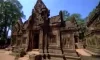
- Television documentary showing the conflict between the villiagers at Lechmore Heath, a small vilage where the UK Hare Krishna Temple, "Bhaktivedanta Manor" is situated. The vilagers were upset that 20,000 Indians would regularly come and drive through their village to go to worship Krishna at the temple. The solution was to build a new access road to the motorway on the other side of the temple. This is a very well made television documentary.
our quarrel this week is between a group of villagers and hindu devotees whose temple happens to be the manor house in the center of their village this is a long-standing and public dispute the villagers want to stop to public worship at the temple because it disrupts their way of life the hindus insist it is their religious duty to worship there lechmoheath is an idyllic green belt village unique in its proximity to london the manor renamed by the devotees bhaktivedanta manor lies in the heart of the village it regularly attracts hindus from the surrounding areas of wembley and watford and is widely regarded as the most important hindu shrine in britain ever since 1973 when george harrison the former beetle purchased the manor on behalf of the hari krishna movement the villagers have been worried about the impact on their lives The influx of devotees and the attendant traffic noise problems have convinced the villagers that their way of life is under constant threat. I want to protect this area.
I don't want people to turn around in 50 years time and say look at the history of Letchmore Heath. Who was that, what was that lunatic committee in 1994 who allowed all this to go on and Letchmore Heath then disappears. On March 16th this year, Hartsmere council responding to villagers demands imposed a ban on public worship at the manor thousands of angry hindus demonstrated in central london and threatened further action within the village really that's just the beginning the community really feel that if they don't get justice they must really make it clear that they cannot tolerate what is happening to them akhandi das the president of the temple is convinced that a proposed access road will divert temple traffic away from the village and should allay most of the villagers fares he believes that bigotry and suspicion are to blame for the deterioration in the situation from the 16th of march the enforcement notice took effect it is now a criminal act for any hindu to come and worship here at the shrine can you believe that that in the 20th century in a democratic country like england people have become criminals from worshipping at the shrine i as their priest i'm now a criminal for letting them into the shrine how is that correct let me suggest to you mr khandadi that there is another side to the picture you have a nice upwardly mobile upward upper middle class professional living in lech moheath and other villages in the green belt and suddenly his universe is uh his sort of idyllic rural setting is uh shattered by this mass demand for hindu public worship at his doorstep i think it's important to note that about 80 percent of those presently living in the village moved in after the establishment of bhaktivedanta manor it is also important to note that there isn't chanting going on up and down the streets that has never been the case over the years further i have heard that a number of the villagers have gone to others and tried to scaremonger amongst themselves that let's more he could be turned into a Southall or a Wembley the real issue is property values many of the villagers have told us that this was the issue that if they can remove the temple from their midst and maybe get a more normal use such as a country club or corporate headquarters then perhaps the values of their home might be enhanced whereas if Hindus move into the village perhaps to be close to the temple then values may depreciate.
What could you do to calm the fears of villagers in Lech Mohit with respect to larger numbers worshipping at your manor temple? We're putting in a proposal that a new access and driveway be created which allows all the pilgrims to come into the manor but avoiding Lech Mohit and in fact avoiding all local residents. It comes straight off the A41 trunk road into the manor over our field there and in that way there's no problems with the local community and at the same time the hindu community can come to worship as they have been doing for 21 years there is an implied criticism that you personally and those of you at the manor temple have not worked hard enough at forging a personal relationship with the village and the villagers i sat with the chairman of the village trust on several occasions I thought we had a good working relationship I feel a little let down by the way things worked out subsequently but I was trying to do things with the village to gain their support for this idea the new access up here is back to the enter manor in the car park that's the village I presume?
That's the village of Lechmor Heath up there. Okay. What we're saying is instead of coming in through there, everyone can come in from this side through the access. Which is the A45?
The A41. What happens if it doesn't get solved? Do you move out? There is no way that our society can move from Bhaktivedanta manner.
We are functioning here as a college and even though there is a ban on public worship and festivals all the other college activities will continue but you have to understand the importance of the manor to us and to the Hindu community not just because of the presence of the shrine in the temple room but because this was the home of the founder of the society Srila Prabhupada Bhaktivedanta Manor was his home the manor was given to him by George Harrison he installed the deities everything about this place is a shrine to him it will never be relinquished by the temple regardless of what happens philip marsh chairman of the village trust which has been the principal voice against the manor feels that any further growth in the temple's activity will destroy the village that he loves he wants the ban on public worship to continue and feels that the villagers have been tolerant enough philip how long have you been in Letchmoor Heath? I've lived in Letchmoor Heath for 23 years but I've been in the area my entire life.
I grew up in Radlet and moved here 23 years ago when we got married. How have you been personally affected in terms of the quality of your life by the burgeoning growth of worshippers at the Bhaktivedanta Manor? We had all sorts of problems with in the early days of the festivals with the car parking and the numbers visiting the manor created a problem with sewage which in fact erupted into the village pond the pipes burst and it's flowed into the village but what i am saying is that if we work from monday to friday and we have chosen to live here this is a peaceful little backwater very close to central london and we've chosen to live here because it is peaceful The Hindus threaten mass action. The villagers want to protect their lifestyle.
Neither will give ground. The access road proposal, offered as an olive branch, has cut no ice with the villagers, who are opposed to any new development of any kind. No solution seems to be in sight. Communications are at an all-time low and suspicions multiply.
Visitors are coming to worship not at the church, but at a Hare Krishna temple. Over August bank holiday, 20,000 pilgrims came for a festival. After 20 years of wrangling and court hearings, the dispute between villagers, the temple and its Hindu worshippers is coming to a head. The conflict is a test case in the balance of rights between local communities and religious minorities.
I frankly do not like confrontation and sadly that seems to be where we are headed at the moment and that I think is worrying. and I would like to try and avoid that. However, that will be, I think, extremely difficult. The Hindu community are considered peaceful and law-abiding and over all the years of this dispute have certainly tried to use the democratic and legal processes but been very frustrated at what they've come across. They are very aware of the types of motivations and attitudes which are behind this dispute.
They do not accept it as purely a planning issue. Vinod and Aradhana have chosen to marry in this temple because they are followers of Krishna consciousness. It's the British Centre of the International Society for Krishna Consciousness or ISKCON better known as the Hare Krishna movement. The temple is popular with the wider Hindu community who aren't followers of the movement but it doesn't have planning permission for public access and the local council has issued an order which, if enforced, would close it for public worship.
The temple president, Akhandadi Das, is leading the fight to keep the temple open to all. In 1973, we asked to be a residential theological college in connection with the promotion of the religion of Krishna consciousness. That is our primary purpose to this day. We have never changed that.
Of course, in 1973, it couldn't be clear to us, and certainly not to Watford Council at the time, that so many Hindus would want to also take part in the activities here. While everyone's repeating, you take some of the grains in front of you and throw them on the fire. Now, there's a lot of grains there, so you can be generous. Although public worship is a breach of its planning status, the temple has become a unique religious asset for many Hindus in a way that the white devotees hadn't anticipated.
The Hindu community are willing to accept, not just ISKCON, but its western-born converts, not only doing the teaching of scripture or the chanting of the hymns, but performing rites of passage, which could be birth ceremonies, weddings, or funerals for their loved ones. This used to be Piggott's Manor. The Krishnas have renamed it Bhakta Vidanta Manor. When Hare Krishna devotees in saffron robes first appeared in the village, they seemed more of a curiosity than a threat to village life.
But as the manor became popular with Hindus living in North London, villagers were disturbed by the unexpected influx. The Latchmore Heath Village Trust became a focus for their views. Two years ago, Philip Marsh reluctantly agreed to become its chairman. my motivation as chairman of the village trust is purely the fact that i have been in this area all my life it is an oasis and i want to protect that oasis and it doesn't matter whether it's the krishnas wanting to develop their site or whether it's the gentleman opposite who has a five and a half acre orchard which he wanted to develop and we fought that and won or just infilling perhaps in a neighbor's garden i would i want the village protected from development and i would like to that in a hundred years time people will turn around and say well thank heaven in 1994 the council and the planners had the sense to stop developing lechmore heath because it needs to be protected for britain's hindu community the local dispute has become an emotive national issue the community usually keeps a low profile but the threat that the manor might be closed to public worship has rallied huge support the bhaktivedanta temple has support from all hindus for two reasons one is that there is a temple quite large and many many of us can go there and participate and the pujas services are carried on very well secondly we don't have any temple nearby if we want to meet for a huge congregation we have to go up to leicester i don't think there is any temple of this size in the near way of the london city at all more in sorrow than in anger 5 000 hindus demonstrated in london on the 16th of march the day on which the council order came into effect banning public worship at the manor they don't close churches down or anything like So why are they closing our manor down?
I am like this temple. I am like this temple. We want to worship and we want to know our rights, what to do with the book. No one believes that any other community would suffer like this.
The government and the local council would never try to close down any other shrine or religious institute in the way that they have treated this temple. It's insane. One of those who joined the march was Bina Vasdev. Neither she nor her sister Santosh had ever been on a demonstration before. are you all right yeah both me and my sister opted to go for the protest march well it was a bit iffy thinking oh protest march they're always very troublesome and so on but when we got there it was a very enjoyable day it was very peacefully done people reciting the prayers as we did the march and i felt that this was very important to me and i decided to do a bit of research on the manna and came to know in depth what the whole issue was and after a couple of visits after that i realized that the the manna sort of gave you the sense of feeling that you were actually at a true hindu temple whereas you're used to the local one which is just a very small temple the hari krishna movement was founded by srila prabhupada he made it his mission to take the teachings of a 15th century Bengali saint to the English-speaking world.
At 56, Prabhupada renounced his family and business responsibilities and went to America. He found a receptive audience, and today the movement has spread worldwide. The Hare Krishna movement takes its initiative from Sri Chaitanya, who appeared at the end of the 15th century. At that time, he took India through the type of reformation that was happening simultaneously in Europe, where he drew the religion out of the temples amongst the people and taught that the scriptures say that the simplest way for everyone to worship God is simply by chanting his holy names, particularly in the form of the Hare Krishna Mahamantra.
Hare Krishna, Hare Krishna, Krishna Krishna, Hare Hare, Hare Rama, Hare Rama, Rama Rama, Hare Hare. So at that time, perhaps the religion was held very much in the hands of the Brahmins in the sanskrit language but he popularized the religion in the form of bhakti devotion to god and made it something that was accessible for all people and it was he who said that one day this chanting of harry krishna would go to every town and village in the world that was something that many of his followers perhaps could not even imagine happening and perhaps it's now with the mass communications and ease of travel or maybe it's a particular era of man that that prediction is now seeing some fulfillment in the late 60s the beatles association with the maharishi mahashyogi took popular interest in the teaching of the east to new heights george harrison met prabhupada soon after his arrival in britain in 1969 and began an association with the hari krishna movement in 1973 he gave them the manor and it became the krishna's principal home built as a gentleman's residence the manor had become a nurse's training center applications to develop the site or turn it into a country club had been rejected but the council confirmed they'd no objection to the krishna's plan to use it as a residential theological college the nurse's sitting room became a temple for the devotees it is based on a tradition in hinduism that focuses on krishna as one of the faces of god and worships him as god one of the earliest british converts to the faith Was Ranshaw prime?
For me, that's the same God as others worship in the Christian tradition, or in the Jewish tradition, or in the Islamic tradition. We're all worshiping the one supreme being. That being, for me, manifests as Krishna. Krishna's name is at the center of every activity.
Devotees are enjoined to recite the Hare Krishna mantra 1,728 times each day. This private observance has its public face in the chanting in Oxford Street. We believe that the sound itself has a special quality, and it makes no difference at all if a person has an understanding of what's going on or not. The name of God is beneficial for everyone.
It's not really aimed at converting people, it's just a way of sharing what we have. Exotic appearance and elaborate rituals are the colourful externals of Krishna consciousness. but when converts decide to become full-time devotees they also commit themselves to vegetarianism and avoidance of alcohol caffeine smoking drugs and gambling those things are considered to be the sort of the enemies really of a life of devotion and service to God we also practice celibacy or else within marriage sex is considered to be a sacred act which is meant for producing children monastic values are matched by a monastic daily routine the first worship of the day is at 430 in the morning it's followed by six more the next at seven o'clock when the devotees also venerate their founder in the form of his life-size wax image. But the manor's innocuous beginnings were to be altered irretrievably by events in East Africa.
In November 1972, the Ugandan exodus began. Most of the refugees were Hindus who had lost a prosperous way of life and arrived with little but their talents. Many settled in North London and the manor became a magnet as a place of worship and an escape from their new beginnings in the inner city. A bond was forged which has become a source of great strength to the Krishnas.
The support of the Hindu community in this country has become tremendously important to the Hare Krishna movement and they have actually welcomed us, I think, in a most wonderful way with sort of open arms and saying that, you know, we love the fact that you have been attracted to Krishna and we want you to be part of our community. So they've accepted us as Hindus rather than us claiming to be Hindus. the krishnas have reciprocated by giving a warm welcome to visitors to the manor those who arrive at meal times are fed without charge for the krishnas it's ironic that their difficulties with the village stem from the support they've found in the hindu community at the root of that support are traditions of belief and worship that overlap for white Westerners. This is a new thing. This is a new tradition they won't have seen before or before its arrival in the late 1960s.
So in that sense, it's certainly new to the West. But in terms of Indian tradition, the things that are valued in the movement can be seen to be valued in other forms of sectarian Hinduism. These traditions are several thousand years older than Christianity and refer to a series of sacred texts which are the sources of Hindu philosophy. They describe the main families of deities.
One centers on the lord of creatures and creative power, the god Shiva. Krishna is in the family of the other main god, Vishnu. Both these are blue as the sky, symbolizing the universe and their divinity. Hindu traditions have found a home in Britain more easily than Hindu architecture.
Most temples have to make use of converted school buildings or houses like this one. This is Bina's local temple. It contains deities in the traditions of both Shiva and Vishnu. She usually worships here once a week.
But she and her family also pray daily at home. First of all we get up in the morning and one by one and have a little prayer just asking the God to give us the strength to complete this day successfully. and then we all sort of set off to work and then we come back and then we usually have a final prayer in the evening just thanking the God for this successful day we've had my father passed it on to us and I'd like to pass it on to my children but it's not forceful it won't be forceful I would teach them and guide them and give them an opportunity to observe some of the rituals both in the temple and in the home but at the end of the day they would choose their route Hinduism is all about a route to reach to one God and it's it's their choice at the end of the day which route they would choose to reach the God I mean there's fears in every faith and every community that they were losing our faith with the younger generation and equally the Hindu community feel the same fear while Bhaktivedanta manner has a number of english-speaking priests most Hindu temples have to rely on one brought over from India.
Many of these lack the English to teach British-born English-speaking Hindus. The temple issue has really worried the older generation because the older generation feel that their own children and grandchildren are moving towards Western materialism and it is religion that can make the children learn behavior, culture, respect for others. So the elder generation are very keen that the temples should be there, especially the Manor temple and more and more temples should speak. Work is underway on the first temple in a traditional style in Britain.
It's being constructed in Neasden, North London, by the largest of the Hindu sects in Britain, the Swaminarayan Mission. It is not easy to get a planning permission in this country for our Hindu temples. We are having a lot of troubles, more or less in every temple whichever we try to set up there. Some sort of obstacles have been put in there by the planning authorities.
There are so many examples. We had this Swami Narayan Mission temple here in Elmenden. We have a temple in Crowley. They are having the same type of problems.
Nearly ten years we are struggling to get planning permission for a temple in Birmingham. And we tried to cooperate with the authorities. Anything they objected, we tried to put away with that. But still, we're finding very difficult to get the planning permission.
Despite being a prosperous and well-organized community, the Swami Narayan mission struggled for eight years to find a site where they could secure planning permission. With this kind of experience repeating itself around the country, the Hindu community is becoming impatient with the planning dispute over Bhaktivedanta Manor. Good evening, ladies and gentlemen. Welcome to a meeting of the Bushy and Alderman Planning Sub-Award.
This council committee is responsible for Letchmore Heath. It's faced with a legacy of two decades of disputes since villagers first complained about the manor. Over the years, visitor numbers of people have come over two days. Local councillors have been divided on whether to ban public worship or accept it as an unplanned development of religious practice.
For many Indian Hindus the normal setting of their local temple will be an urban inner city location. So visiting beautiful sites is obviously an important part of pilgrimage activity in this country and that's an activity that Indian Hindus are very keen to keep up. Pilgrimage has been important in the Indian Hindu tradition since the time of the early epics and hindus are enjoined to go on pilgrimage they're encouraged to do so and obviously they're limited in what they can do in this country after taking part in the demonstration in westminster earlier in the year bina and her sister santosh were determined to take their children to visit the manor at janmashtami for every hindu person it is absolutely essential to have a yatra which which is a pilgrimage, and this would be like a yatra for us. And then I think it's very important that, you know, who knows what will happen next year.
The manor may be no longer open to the public. Hello. Gentlemen, to me, happy. Happy to be a gentleman.
And I think it's very essential that I give the opportunity to my children to experience something they would experience in India. So it is a yatra for us, a pilgrimage. All over the country, thousands of Hindus are converging on Lechmore Heath as they make their pilgrimage to celebrate Krishna's birth. When it was started, the Indian Hindu community was only beginning to develop in this country in terms of the development of its own temples.
The first temple in this country, Indian Hindu temple, was only started in 1969. So the extent of interest in attending temples, in developing festival programs, in going on pilgrimage, that was not known at that time. that could not have been known and that really what has happened is that the popularity of the worship has really developed in an incredible way that couldn't have been known. It is because we are a college that the standard of worship on the shrine is maintained according to the scriptural standards, a standard which is not met in any other Hindu temple in this country. Being a college has created the problem if you like now the real question is not to try and stop the pilgrims and cut them off from their shrine but really how can we cope with this interest in a way that doesn't detract from the locality or from the lives of local villagers i think perhaps they've been a little naive i think even they will say they were surprised by the numbers that were attracted and i I think it was perhaps naïve for them to carry on as they were without making some official approach to the council or the village or whatever, so that we could actually sort the thing out at the very start rather than let it get to the stage to which it has got now.
I feel that the villagers should sacrifice some of their comforts for this temple's sake because it brings joy to many, many thousands. Not only that, the very Christian religion says that you have to respect others' feelings and allow them to have. I think local people can learn tolerance and keep quiet. There are those in the village who sympathize with this view.
Roger Hewlett is the dissenting voice among the seven members of the village trust. A few vociferous people have generated a standard viewpoint on the Krishnas. And it's become the accepted truth. And therefore, whenever the situation is discussed, mainly what is heard is that their view about there being a serious problem there and that the only answer really is for them to be forced to go back to the original planning permission without any notion that, in fact, we've moved on, that they've lived there for 20 years, that during that time, by and large, there's been very little trouble. and that there is an alternative view in the village about it.
Numerous attempts were made by the council and the manor to agree the number of festival days and acceptable numbers of visitors at weekends and festivals. The manor even indicated it hoped to find an alternative location. But in 1985, the council began to move towards enforcement of the manor's planning status as a residential college on the grounds that agreed limits were being breached. The temple president believes the shift reflected other developments.
There was two Hindu families who had purchased houses in the village. This created quite a furore among some persons who felt that property values were in jeopardy and that the village would be taken over. When they did buy the houses in the village, there was a rumour, and I could say no more than a rumour, but it was a fairly strong rumour, that it was their intention to actually take over the village. now far from being a worry about property prices we were worried about the village being taken over i think that it would be a very unusual village if we could say there is no racial element to this question i don't personally i've not encountered much overt racial hostility but i think the fact that they are asians mainly who visit the temple they are from a religion that most people in this village don't really understand.
And they are seen by some people as outsiders or immigrants and really they should know their own place. I think that has tended to cloud some people's thinking about it. The manor appealed to the Secretary of State for the Environment against the council's ban on public worship and festivals like Janmashtami. On such occasions the manor's grounds can accommodate the crowds.
At Janmashtami, a circus tent is erected and a play is performed to entertain the visitors, as Krishna's birth isn't celebrated until midnight. After a public inquiry, the government gave the manor two years to find another site. This period expired in March, and the Krishnas appealed to the European Court of Human Rights. The court decided that planning regulations override freedom of religious practice, and The council then reminded the manor that public worship and the celebration of festivals like Jan Mastami is now illegal.
My mind is as fixed as the northern... We discussed this with the president. I indicated to him very clearly that if he proceeded with Jan Mastami, then that was leaving himself and others open to a prosecution. It was not, however, open to me to guide and advise him.
The decision must be his. and equally I had had representations from some of the villages that they were concerned if the gates were locked and of course devotees would come into the village and would pay homage to the shrine on the roadside and clearly that would have created difficulties for the police. As things stand, technically the very holding of the festival is a breach of the enforcement notice and we would need to determine the attitude and likely response of the courts to bringing a prosecution. The Krishnas hoped to solve the problem by obtaining permission for a new road that would avoid the village altogether. It would cut through fields at the back of the manor and link it to an existing lane which provides a route to the main road.
But the plan has only created new suspicions. I think the real issue is this latest planning application which obviously is trying to legalize, as far as planning laws are concerned, everything that they do. We are not a very wealthy community, but the alternative that has been offered by the government is to build a new temple elsewhere. Imagine the cost of that.
You're talking millions and millions of pounds. I think that the road is a huge problem. The Christians will say it is the solution to all the problems. I'm afraid I believe it will bring with it other problems that we haven't even or that perhaps the Christians haven't even thought about residents of the nearby hamlet patch its green fear that traffic would turn in their direction instead of going directly to the main road councillors for patch its green understand the manners importance to Hindus but oppose the proposal well I'm and my group are very strongly against the road proposal because we see it as a means of transferring the problem from the village of lateral eve into the village of patchett's green happens to be an area i represent and i know and i feel in sympathy with my constituents that that this is not a proper solution when the council met on the 12th of july to discuss the manor's application for the road they had to be brought by bus through a hostile demonstration but the meeting failed to reach a decision for two days through the After the afternoon, evening and late into the night over August Bank holiday, traffic streamed through Letchmore Heath into and out of the manor.
The Krishnas have appealed to the Secretary of State for the Environment and there will now be another public inquiry to decide on the road. The council is due to meet again on the 19th of October. It will be presented with evidence collected on Janmashtami and will have to decide whether to take the Krishnas to court for holding the festival. have to be against public worship because if you give public worship and no road life would be absolute murder in the village and the road brings with it other problems if it were a theological college in a place of retreat then two or three times a year to have a festival would not be asking too much of the village so i'm afraid i feel that that is what it has to now become the shrine is here that the harry krishna temple is here and discussions about whether it should be somewhere else or whether it be best moved somewhere else are in that sense irrelevant bethlehem is where bethlehem is and it's no good saying that it would be much more convenient if it were on you know handy for the m25 where more people would visit the temple is here it's important that it is here for people who worship there and from my point of view that's the end of the discussion.
Midnight approaches the moment of Krishna's birth and the climax of the festival patient pilgrims queue for a place in the temple. Veena and Santosh have managed to squeeze into the packed temple they want this experience to be a memory as important for their children as for themselves it's the realization of their pilgrimage. I don't really see the manor closing down because it is a place of worship and everybody has the right to worship as they please but the hindu community is very much united and are willing to come across very forcefully if need be they're holding back for a very positive outcome hoping that it will be resolved peacefully i don't think anyone who has witnessed what happens here at janmashtami time can fail to understand the importance of this shrine for the hindu community I honestly feel that it's about time that somebody had a little bit of sympathy for the village which has been here since 1299 and I'd like to see some sympathy sent our way instead of away from us.
If the manor is prosecuted by the council this could be the last public celebration of Janmashtami at Bhaktivedanta Manor. The Krishna's request for the new road rests with the Secretary of State for the Environment. He will have to decide whether planning regulations and the views of local residents should override freedom of worship.


